

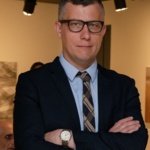

With this in mind, Art History and Theory professor Jakub Zdebik was recently awarded the SSHRC Insight Grant for his project “AI and the Mutation of the "Artificial" in Contemporary Art Images.”

Dr. Zdebik will seek to bring humanities into a discussion usually reserved for corporations, engineers and scientists, who, despite bypassing an understanding of art's relationship to beauty, society and creativity, utilize these concepts with confidence to bolster claims that AI is another form of intelligence. In fact, Dr. Zdebik’s project, instead of focusing on the usual target of cultural criticism which aims at AI, namely the questioning of "intelligence," which can be seen as a form of high-speed organization (Sadin, 2018), focuses on the "artificiality" part: accepting that art works with artifice, illusion and representation—AI art accelerates these terms to such a degree as to mutate the notion of artificiality.
Incorporating AI into Art History
The aim of Dr. Zdebik’s research is to categorize the ways AI interacts with art in order to better understand the current state of affairs by making an art historical survey of how art has combined with technologies for over one hundred years. Avant-garde artists were often early adopters of new technologies and pondered technological limits by putting technologies through the artistic ringer. By surveying the writings of aesthetic theorists, applying these to art historical texts about recent artistic developments, and analyzing artworks generated by AI and by artists with the help of AI, I intend to ask questions about what advances in AI our conception of artificiality. With a multidisciplinary approach, I will explore how aesthetic theory reflects on AI art practice and the techno-cultural industry from the point of view of societal priorities.
Some of Dr. Zdebik’s findings can be found in the following essay: “The Landscape Sees: Deleuze’s Percept and Catastrophe in Painting and AI-Generated Images.”