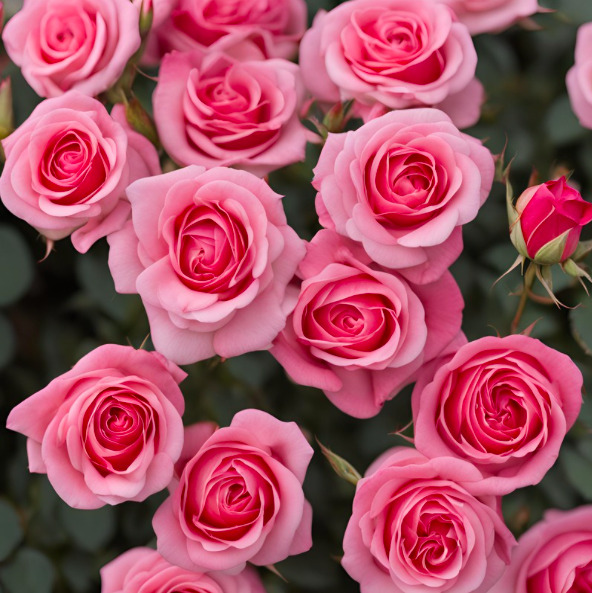
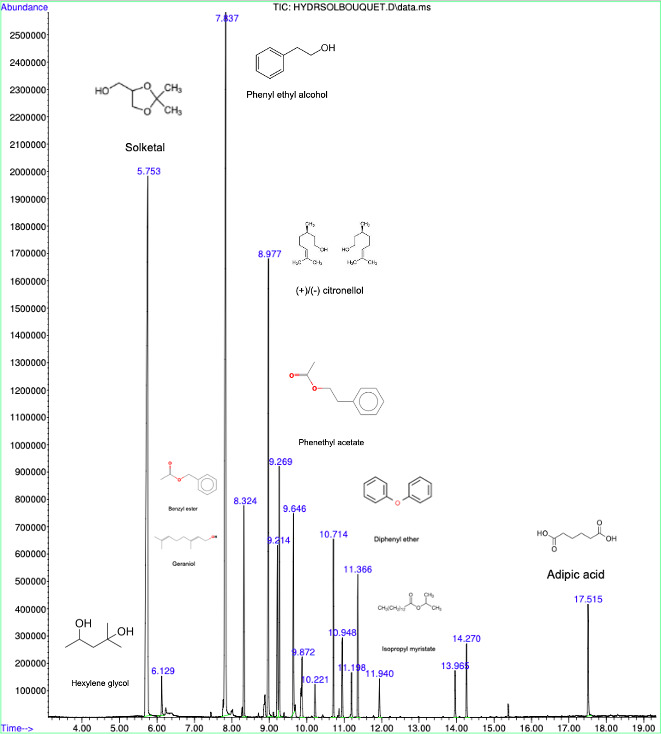
First, we analyzed the “rose bouquet” fragrance, which smells like a delicious bouquet of fresh, fragrant roses and we obtain 18 compounds.
Phenyl ethyl alcohol is the main product with a retention time of 7,837 and a surface area of 26,02%. It is a primary alcohol found in extracts of rose, carnation, hyacinth, Aleppo pine, orange blossom, ylang-ylang, geranium and neroli. Its structure enables it to have aromatic and chemical properties notably used in the perfume industry. It is also an anti-microbial agent, antiseptic and disinfectant, and is widely used for its preservative properties.
The second compound present in large quantities is solketal. It is used in the perfume and cosmetics industry for its odorant properties and perfume-fixing capacities.
Finally, the third compound present in large quantities is citronellol with a retention time of 8,977 and an area 10,94%. It is a natural acyclic monoterpenoid. Both enantiomers occur in nature. (+)-Citronellol, found in citronella oils, is the most common isomer. (-)-Citronellol is widespread, but particularly abundant in rose.
Then we have geraniol in small quantities, with an area of 3,41%. It’s a monoterpene and makes up a major part of rose and palmarosa oils.
We also have the hexylene glyccol, famous for its excellent solvency among a wide variety of materials and is popular due to its ability to improve the texture.
Finally, isopropyl myristate, used in cosmetics and pharmaceuticals to facilitate penetration of products into the skin when emulsified with water.